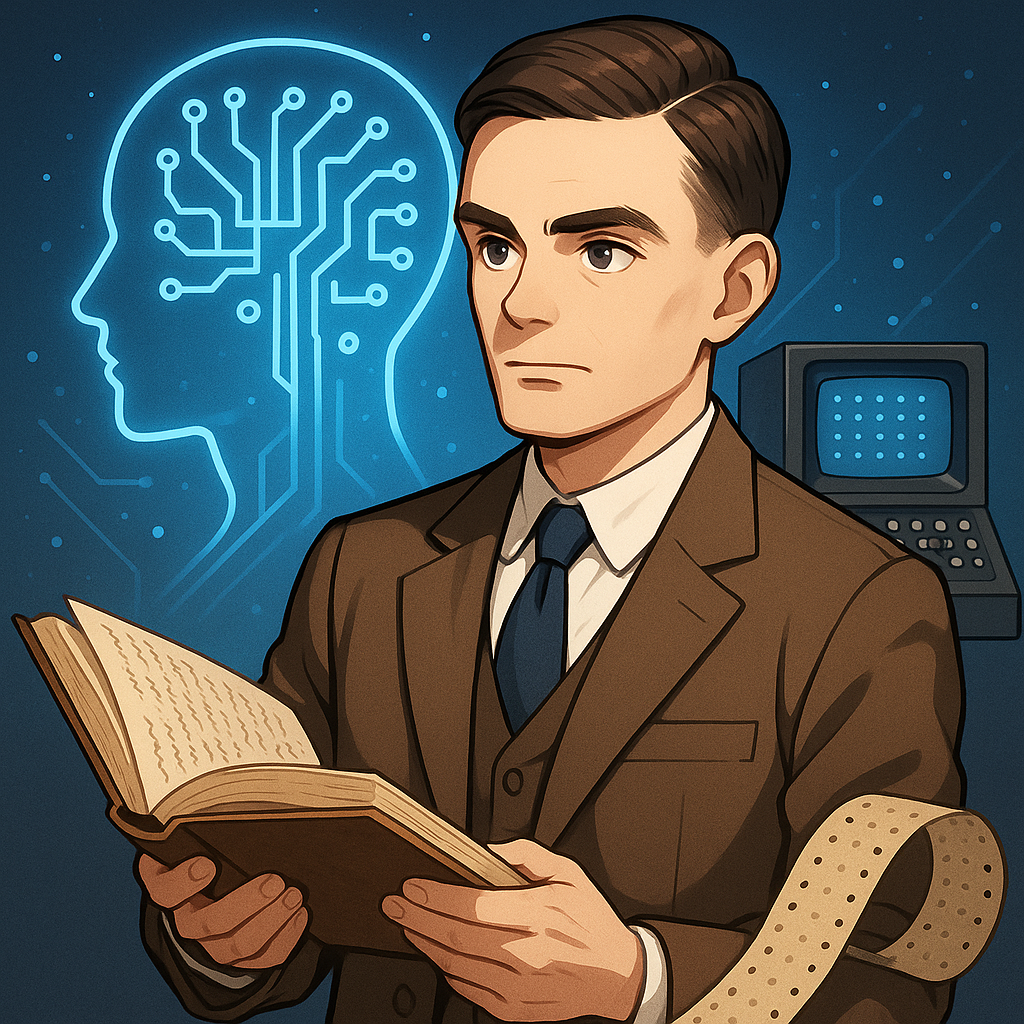


Even though the term “Artificial Intelligence” (AI) was introduced in 1956, its official beginning is connected to an important paper published by Alan Turing in 1950. In this paper, Turing established the theoretical foundation for machine intelligence, proposed a method to evaluate it, and laid the groundwork for AI to develop as a scientific field.
Turing’s Visionary Leadership
In October 1950, the British mathematician Alan Turing published his significant paper titled “Computing Machinery and Intelligence”. In it, he asked a question without an easy answer: “Can machines think?”. He designed what is now known as the famous Turing Test to evaluate a machine’s ability to exhibit intelligent behavior that is indistinguishable from a human.
At the dawn of the computer age, when early computers were referred to by the media as “electronic brains,” Turing’s paper initiated a deep discussion about the nature of machine intelligence. Notably, the term “Artificial Intelligence” did not emerge for another six years. Turing explored formal calculations, algorithms, and the operational principles of computers, and also discussed the computational and memory capacities required for intelligent behavior. He delved into the theoretical limitations of machines, connecting these to questions of computational capability and formal logic, which are deeply rooted in the foundations of mathematics. Turing proposed that the increasing computational power of machines would inevitably raise questions about the essence and status of intelligence.
Early Neural Networks and SNARC
In 1951, the American mathematician Marvin Minsky made a significant contribution to the field by creating the SNARC (Stochastic Neural Analog Reinforcement Calculator), which was the first simulator of a neural network. This machine modeled the behavior of a mouse navigating a maze, marking a pioneering step in artificial neural network research.
The foundation for this achievement was laid in 1943 by Dr. Warren McCulloch and the young mathematician Walter Pitts, who, based on the discoveries of Santiago Ramón y Cajal, modeled neurons using electromechanical relays. These relays acted as Boolean automata with two states (true or false), determined by whether the switch was open or closed. The next state depended on the inputs and the previous state. By networking these automata, some of their weighted outputs became inputs for others. Drawing an analogy to the brain, McCulloch and Pitts called the automata “formal neurons” and the weighted connections “synaptic connections”. Minsky’s SNARC physically implemented this formal neural network using vacuum tubes, enabling autonomous learning based on principles laid out by psychologist Donald Hebb. In SNARC, the synaptic connections between the formal neurons were strengthened through repetitive electrical stimuli, leading some to consider it the first self-learning machine.
The Birth of a Field
In 1955, at the age of 28, Marvin Minsky, along with John McCarthy, proposed a summer school to explore a new field they named “Artificial Intelligence”. Their goal was to use computers to study and simulate various aspects of intelligence. With the sponsorship of Nick Rochester, Scientific Director at IBM, and Claude Shannon, the renowned father of information theory, the proposal was submitted to the Rockefeller Foundation, which provided the funding.
In 1956, the summer school held at Dartmouth College in Hanover, USA, and organized by McCarthy, Minsky, Rochester, and Shannon, marked the official birth of AI as a scientific field. The organizers aimed to simulate various forms of intelligence—human, animal, plant, social, and phylogenetic—through machines. They argued that cognitive activities, including learning, reasoning, computation, perception, memory, scientific discovery, and artistic creativity, could be described with enough precision to be programmed into computers. This hypothesis, still unproven but productive, has driven AI research for over six decades.
Turing’s Imitation Game and Learning
Turing argued that if human intelligence is identified through reasoning, a machine demonstrating similar capabilities would challenge our understanding of intelligence. He systematically addressed objections to the idea of intelligent machines and emphasized the importance of learning as a crucial capability for machine intelligence. Turing introduced the concept of randomness in metaheuristics for problem-solving, foreshadowing future AI techniques. His imitation game provided a framework for evaluating intelligent behavior, sparking debates and experiments that paved the way for AI research.
The Perceptron and Early Machine Learning
A major milestone occurred in 1957 when the American psychologist Frank Rosenblatt introduced the perceptron algorithm at the Cornell Aeronautical Laboratory, funded by the U.S. Office of Naval Research. The perceptron was a supervised learning algorithm for binary classification, designed to separate data into two classes. As the simplest form of an artificial neural network and a linear classifier, it required training data to sort items into two groups. Initially implemented as software for the IBM 704, the perceptron was later executed on a machine called “Mark 1,” designed for image recognition. This machine had 400 photocells connected to its neurons, with synaptic weights coded on potentiometers and adjusted by electric motors during the learning process.
Hailed as a breakthrough, the single-layer perceptron was limited to linearly separable classes. However, these limitations were overcome with the discovery of the multi-layer perceptron, which could classify non-linearly separable groups, providing solutions to more complex problems.
Reinforcement Learning and Beyond
In 1959, Arthur Samuel published the first reinforcement learning algorithm, which tested multiple solutions, observed environmental responses, and adjusted strategies to optimize outcomes. This approach laid the foundation for adaptive AI systems. The 1950s not only established AI as a scientific field but also produced foundational results in machine learning, neural networks, and reinforcement learning. These early developments sowed the seeds for deep learning, which would later become a cornerstone of modern AI.
Key Takeaways
- October 1950: Alan Turing’s “Computing Machinery and Intelligence” posed the question, “Can machines think?” and established the theoretical basis for artificial intelligence.
- Six years later, in 1956: The Dartmouth College summer school, organized by John McCarthy, Marvin Minsky, Nathaniel Rochester, and Claude Shannon, formally established AI as a field dedicated to simulating intelligence with computers.
- The term “Artificial Intelligence” was introduced during this event.
- In 1957: Frank Rosenblatt’s perceptron algorithm introduced neural network-based learning, followed in 1959 by Arthur Samuel’s reinforcement learning algorithm.
- These milestones launched artificial intelligence as a dynamic and transformative field.